


Do CBD Topicals Actually Help With Joint Pain After 50
Aug 29th 2026
Something keeps coming up with our older customers. They stop in or reach out online not because they're chasing a trend, but because their knees have started talking back after a morning walk, or their hands feel stiff before they've even had their coffee, or an old shoulder injury has decided to become a daily conversation. They've tried the usual stuff: the gels from the pharmacy, the heating pad, the occasional ibuprofen. Someone mentioned CBD topicals, and now they want to know if there's anything to it.
We're not going to oversell this. The honest answer is that people have real results and real non-results, and a lot of that comes down to product quality and whether someone is using the right thing for what they're dealing with. Here's what we actually know.
Why Are Sore Joints Sending People to CBD Topicals?
Joint stiffness in your 50s and 60s is largely a numbers game. Cartilage thins. Inflammation tends to settle in and stay. The body just takes longer to bounce back from things that used to roll off it: a hard workout, a long drive, even a night of poor sleep. Managing daily discomfort means either staying ahead of it with movement and care, or reaching for something that takes the edge off when things flare.
CBD topicals show up in that conversation because of how they work at the skin level. You apply a cream or balm directly to the area that's bothering you, and the cannabinoids interact with receptors in the surrounding tissue. They don't enter the bloodstream the way an edible or tincture does. The effect stays localized, which is a genuinely useful quality if one specific joint is the issue and the rest of you is fine.
Most of our older customers are skeptical when they first ask about this, and that's fair. They've been told plenty of things would help their knee. What tends to bring them back is that CBD topicals did something the pharmacy option didn't, and the first question after that is usually about concentration and format.
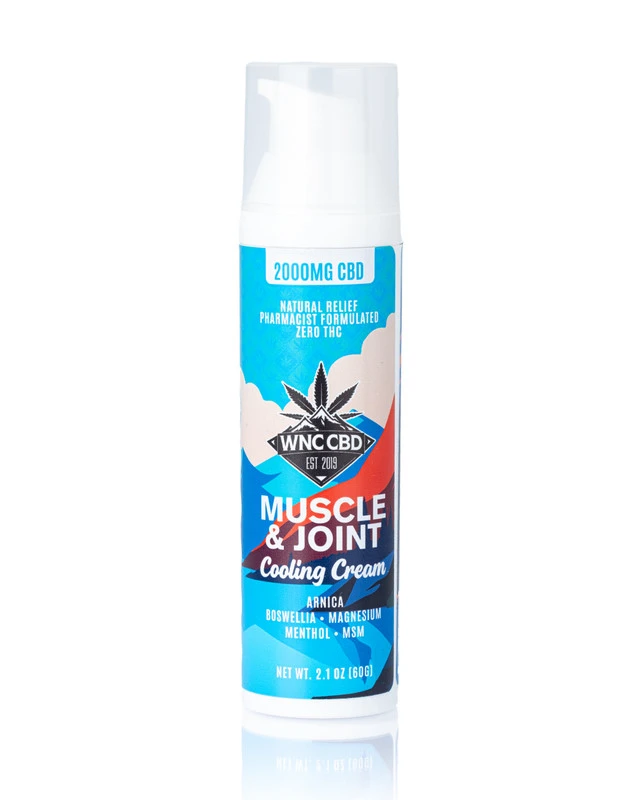
Our Muscle & Joint Recovery CBD Cream (2000mg) is what we'd point someone toward first. It absorbs without leaving a greasy film, applies easily, and contains zero THC.
Not All CBD Topicals Are Made the Same
A lot of products on the market label themselves as CBD topicals and then contain 250mg or 300mg of CBD in the entire bottle. At that level, you're mostly buying a lotion with a CBD label on it. If you've tried something before and felt nothing, low concentration is the most common reason.
Topical CBD for inflammation tends to work better when the formula uses full spectrum hemp extract instead of CBD isolate. A full spectrum CBD topical brings along the minor cannabinoids and plant compounds that occur naturally in hemp, and they tend to work better together than any single compound would on its own. The formulation matters, not just the number on the label.
Our Extra Strength Muscle & Joint Recovery CBD Cream (5000mg) contains full spectrum hemp extract and is the option we'd lean toward for people dealing with deeper or more persistent discomfort, the kind a 2000mg product hasn't been enough for. We also carry an Extra Strength Healthy Nerve Cooling Topical at 5000mg, built for people whose discomfort includes a nerve component: the tingling, the burning, the ache that doesn't quite sit in one defined spot. CBD topicals at this strength have a different ceiling than what most people have tried, and both contain zero THC.
Hemp topicals at this concentration just aren't widely stocked in traditional retail. That's a real part of why people end up looking for them elsewhere.
Roll-On or Cream: Does the Format Actually Change Anything?
It does. A CBD cream for pain covers a broader surface area and handles larger joints well: the knee, the hip, the lower back. You apply it, work it in, and you're done. Our 2000mg Muscle & Joint Recovery Cream is the right fit for daily maintenance on areas like those.
The roll-on version of that same formula is about precision. You can apply it exactly where it needs to go: a specific knuckle, the side of an ankle, a defined point along the knee, without getting product all over your hands.
People dealing with finger arthritis often prefer the roll-on for exactly this reason. Applying a cream means using the same hands that are already causing trouble. Several of our customers keep both, the cream at home and the roll-on for when they're out.
For people comparing the best CBD balm to a cream, it usually comes down to texture and contact time. Balms are thicker and sit on the skin longer. CBD salve benefits come from that extended dwell time, which works well for areas that don't flex as much. For joints that move a lot throughout the day, a cream or roll-on absorbs faster and tends to feel less heavy.
What's Worth Checking Before You Buy CBD Topicals
People buy CBD topicals online for good reasons: better selection, more product information, and access to things you won't find at a local pharmacy. A few things are worth verifying before you commit.
Third-party lab testing is the one you don't skip. Certificates of analysis tell you the actual CBD concentration in the product, confirm the absence of pesticides and heavy metals, and show the THC content. For anyone in their 50s or 60s who has no interest in any psychoactive effect, that last point is the one to nail down. Every topical we carry contains zero THC. No guessing required.
CBD skincare products sit in a category with enormous quality variation, and price doesn't reliably tell you what you're getting. A $30 product and a $120 product can both be made well or made poorly. Lab reports are what you're actually looking for, not the price tag.
Give the product time before drawing any conclusions. A single application won't tell you much. Using something consistently on the same area for a week or two gives you a real read on whether it's working. Most people who find lasting value in CBD topicals treat them like a routine rather than a one-time experiment.
If joint discomfort has been slowing you down, we're glad to help you figure out which product makes sense for your situation. We'd rather you find something that actually works for you than sell you something that doesn't.
Disclaimer: This content is provided for general educational information only. It is not intended to instruct or encourage the use or processing of any product in violation of applicable law. Hemp and cannabinoid laws vary by jurisdiction and are changing.